
Offshore Transits
A to B. No shortcuts.
Offshore sailing from the Mediterranean to the Canary Islands — or back. Real miles, real watchkeeping, coached from departure to arrival.
Med ↔ Canary Islands · Autumn & Spring
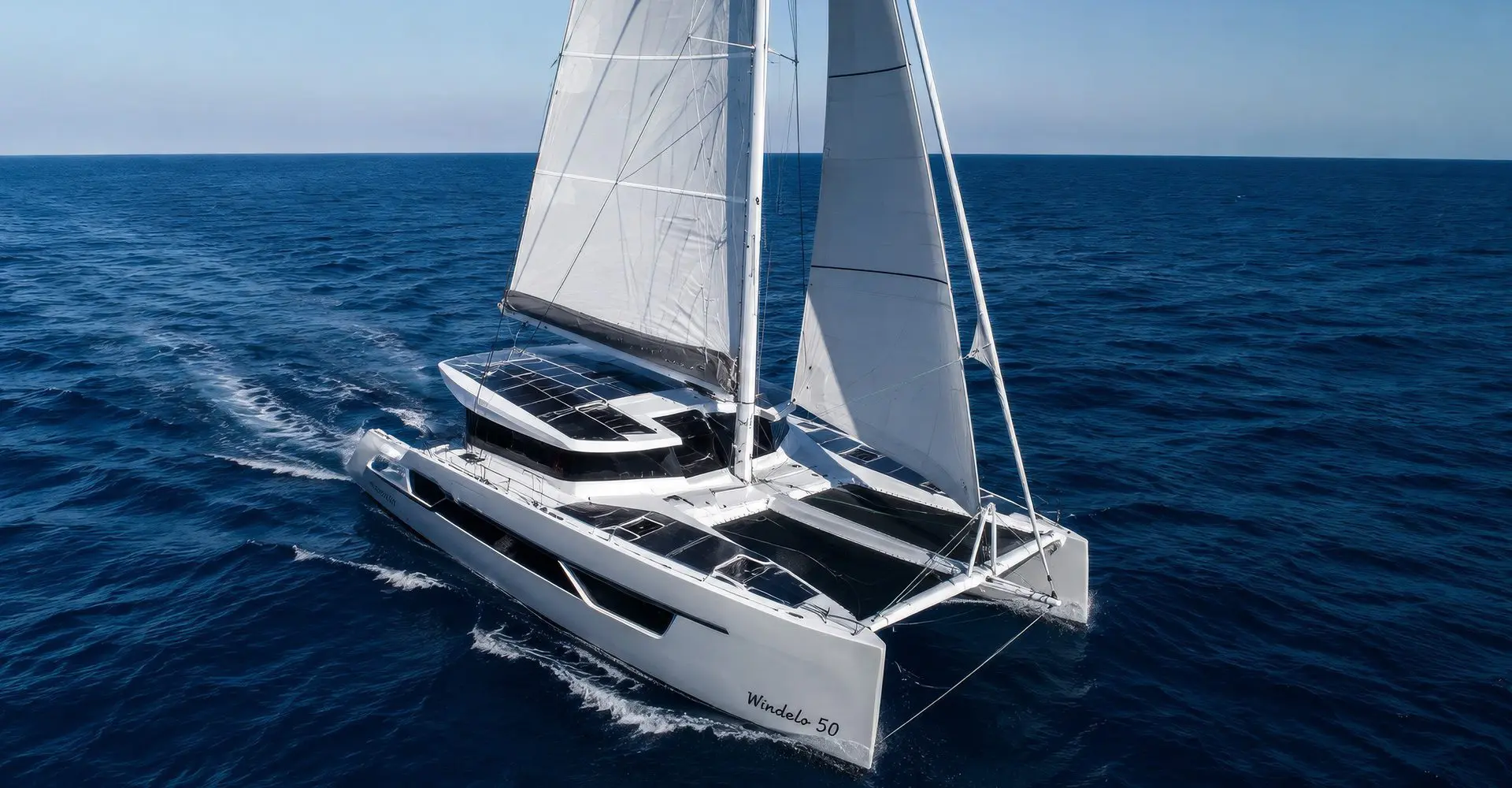
Not a cruise.
A passage.
A transit is a point-to-point offshore sailing passage. You leave one port and arrive at another, covering real open-water miles in between — typically five to ten days at sea, depending on the route and conditions.
There are no daily returns to the same marina. No option to skip a day if the weather is uncomfortable. Once you are offshore, you are offshore — and you manage what comes.
That is exactly the point.
On a Volt Sail transit, you join the watch system from day one. You stand your watch, take the helm at sea, make routing decisions alongside the coach, and experience what offshore sailing actually requires of a crew — not in theory, but in practice.
The watch systemWatches run around the clock offshore. You will stand yours — typically three to four hours on, rest off. This is how passage-making actually works.
Routing decisionsWeather windows, swell patterns, fuel and energy planning, route adjustments underway. You are part of those decisions — not just informed of them after the fact.
Real offshore milesThe Med to Canary Islands route covers roughly 1,000 nautical miles of open Atlantic. Night sailing, shipping lanes, variable conditions. Not a delivery — a coached passage.
The routes
We run two primary transit routes, timed around the seasonal weather windows. Both are offshore passages — the direction determines the timing and the wind.
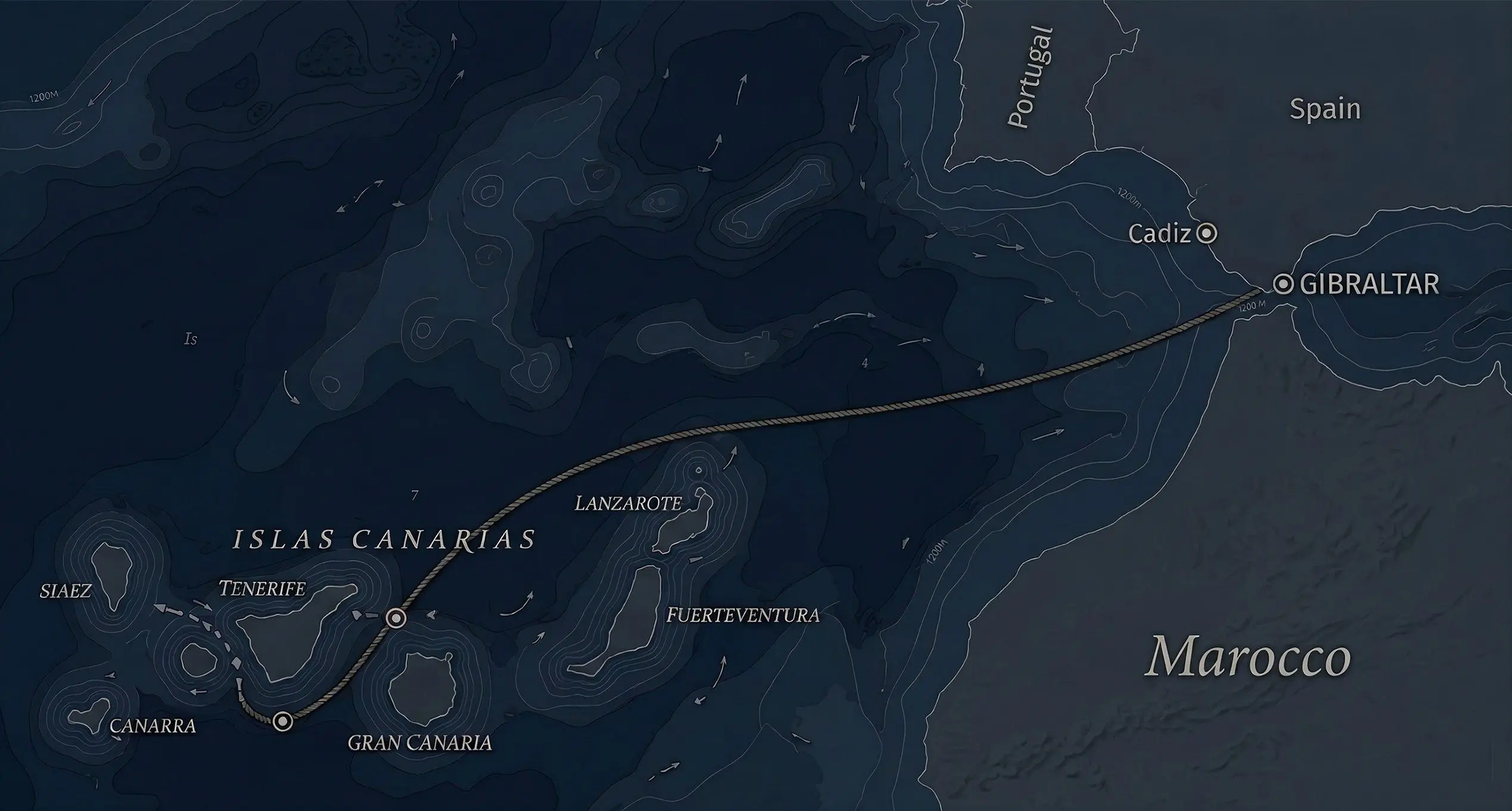
Autumn
Mediterranean to Canary Islands
The classic autumn passage south. Departing from the Spanish Mediterranean coast — typically Valencia or the Balearics — and sailing south-west to the Canary Islands via the Portuguese coast or direct offshore. The prevailing northerly winds make this the preferred direction: mostly reaching and running, with good boat speed for a performance catamaran. Typically November, depending on the season’s weather pattern.
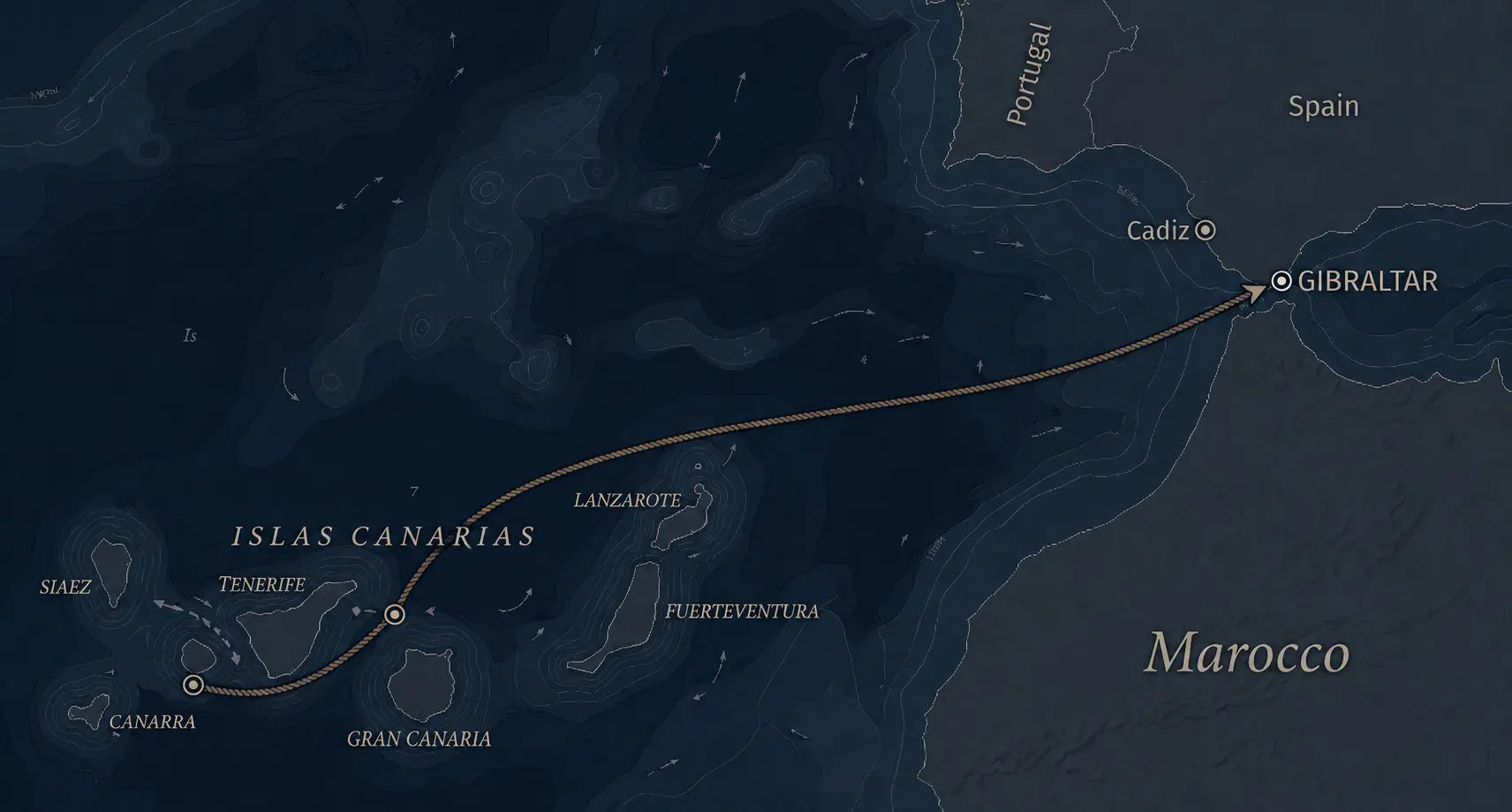
Spring
Canary Islands to Mediterranean
The return passage north. Departing the Canary Islands in late winter or early spring, heading back towards the Mediterranean. The wind pattern is less straightforward than the autumn run — this passage requires more tactical thinking, and conditions can be variable. That makes it a stronger coaching passage for sailors who want to work on routing and decision-making under pressure.
How watchkeeping works
Offshore sailing runs on a watch system. Here is what that looks like in practice aboard Nyota.
Departure
We depart with a weather window and a routing plan. You are briefed on the passage, the watch schedule, and what we will be monitoring offshore. From the moment we leave the dock, you are part of the crew.
Offshore rhythm
Watches rotate around the clock. During your watch you are responsible for the boat — monitoring conditions, trimming sails, logging position, and calling the coach if anything needs a decision. Rest periods are real rest.
Routing decisions
Each day we assess the weather, the boat’s progress, and the route ahead. You are involved in those discussions — understanding the reasoning, not just the outcome. This is where offshore competence is actually built.
Arrival
We arrive together. The debrief covers what you handled well, what you would do differently, and what the passage revealed about your sailing. Most people finish a transit wanting to do another one.
What the passage
teaches you.
Offshore sailing compresses a lot of sailing development into a short period. These are the areas the coach focuses on during a transit.
Watch discipline
Standing a proper watch — what to monitor, when to call for help, how to hand over cleanly to the next person. The habits that keep an offshore boat safe.
Sail handling at sea
Reefing in the dark, gybing in swell, sail plan decisions as the wind builds or drops. These are different on a performance catamaran than on anything smaller.
Weather and routing
Reading GRIB files, understanding routing software, making decisions when conditions do not match the forecast. Real offshore thinking, not classroom navigation.
Night sailing
Navigation lights, AIS, shipping lane awareness, how to stay alert on a night watch. The first few nights offshore change how most sailors think about the sea.
Energy management offshore
Running a fully electric boat on passage: solar input, consumption under load, motoring decisions when the wind drops. The discipline is different at sea than at anchor.
Systems under pressure
What to check, what to monitor, and how to respond when something is not right. Offshore competence is partly about sailing — and partly about not panicking when the boat talks to you.
Good fit.
Not a fit.
Good fit
- You have some sailing experience and want to step it up significantly in a short period.
- You are comfortable with the idea of being offshore — out of sight of land, at sea for days at a time.
- You want to understand watchkeeping, routing, and offshore decision-making from the inside.
- You are considering a passage of your own — an Atlantic crossing, a Med circuit, a long coastal hop — and want to prepare seriously.
- You are fine with variable conditions, and understand that the sea does not provide guaranteed comfort.
Not a fit
- You have never sailed before and are expecting a gentle introduction to the water.
- You need a fixed daily schedule and guaranteed weather.
- You are uncomfortable with the idea of being at sea overnight or out of sight of land.
- You are looking for a relaxed coastal cruise with optional sailing involvement.
What to know
before you book.
Duration8–14 days
Guests1–4
SeasonAutumn & Spring
Experience neededSome sailing background
Experience level
There is no minimum certification required, but transits work best for sailors who have some time on the water — coastal passages, crewed trips, RYA or equivalent courses. If you are unsure whether your background is sufficient, tell us during enquiry and we will give you an honest answer.
Kit and preparation
Offshore sailing requires proper foul weather gear, a harness, and a few other essentials. We will send a detailed kit list after booking. Do not show up in deck shoes and a t-shirt.
Group bookings
Transits run as whole-boat charters for groups of two to four, or as individual berths when we have availability. Solo sailors are welcome — you will not be the only person standing watch.
Pricing
Transit pricing depends on the route, duration, and whether you are booking a whole boat or individual berths. See our Pricing page for the framework, or contact us directly for current availability and rates.
All transit departures depend on weather windows. We do not leave on a fixed calendar date if conditions are not suitable. Passage durations are estimates — offshore sailing does not run on a timetable.
Common questions
Do I need an offshore qualification?
No formal qualification is required. What matters is that you have some sailing background and are honest about it during enquiry. The coach will calibrate the passage to what you can handle — but offshore sailing is not the place to discover you are not comfortable at sea.
Can I join as a solo sailor?
Yes. When we have individual berths available on a transit, solo sailors are welcome. You will be sailing alongside one or two others on the same passage. We do not mix people with fundamentally incompatible goals — expect a shared briefing on expectations before departure.
What happens if conditions deteriorate during the passage?
The coach makes the call on routing and safety. If conditions require a course change, a stop, or a different routing decision, that is what happens. Part of what you learn on a transit is how those decisions are made — you will be part of the conversation, not sheltered from it.
Is this a delivery voyage?
No. We are not moving the boat for logistical reasons — we are sailing it as a coached passage. You are not crew on a delivery; you are a participant in a sailing programme that happens to cover real offshore miles. The distinction matters in terms of how the passage is run and what you get out of it.
What experience do I need for the spring (northbound) route?
The Canary Islands to Mediterranean route is more tactically demanding than the autumn run south. We recommend having at least some offshore experience — a previous transit, a long coastal passage, or equivalent — before joining the northbound route. If in doubt, start with the autumn passage.
Ready to go offshore?
Tell us which route interests you, your sailing background, and your rough timing. We will come back with current availability and a clear sense of whether a transit is the right fit.