
Electric Catamaran Sailing
The engine is silent. The sailing isn't.
What changes when you remove diesel from the equation — and what you learn to manage in return.
Windelo 50 · Electric Propulsion · Mediterranean
The first day
What changes before
you leave the marina.
Most of what people expect about electric sailing turns out to be true — but not quite for the reasons they imagined. The silence is real. The cleanliness is real. What surprises people is how quickly they stop noticing those things, and start noticing something else: the energy. There is a state of charge to watch, a solar forecast to factor in, and a passage to plan around what the boat can provide. That is the part that takes a day or two to settle into.
No exhaust
Motoring out of harbour on electric produces no smoke, no diesel smell, no black cloud at the stern. The cockpit stays clean. Guests below don’t wake to fumes. It sounds like a small thing until you have spent a week on a diesel boat.
Near silence
Twin electric motors produce a low hum rather than diesel clatter. In light air, motoring and sailing blur together — you are aware of movement, not machinery. At anchor with the generator off, the only sounds are wind and water.
A different relationship with power
Instead of a fuel gauge, you have a state of charge reading. Instead of filling a tank, you watch the solar input, track consumption, and make decisions accordingly. This is not a complication — it is a different layer of boat management that becomes routine within a day.
The system
From sun to propeller.
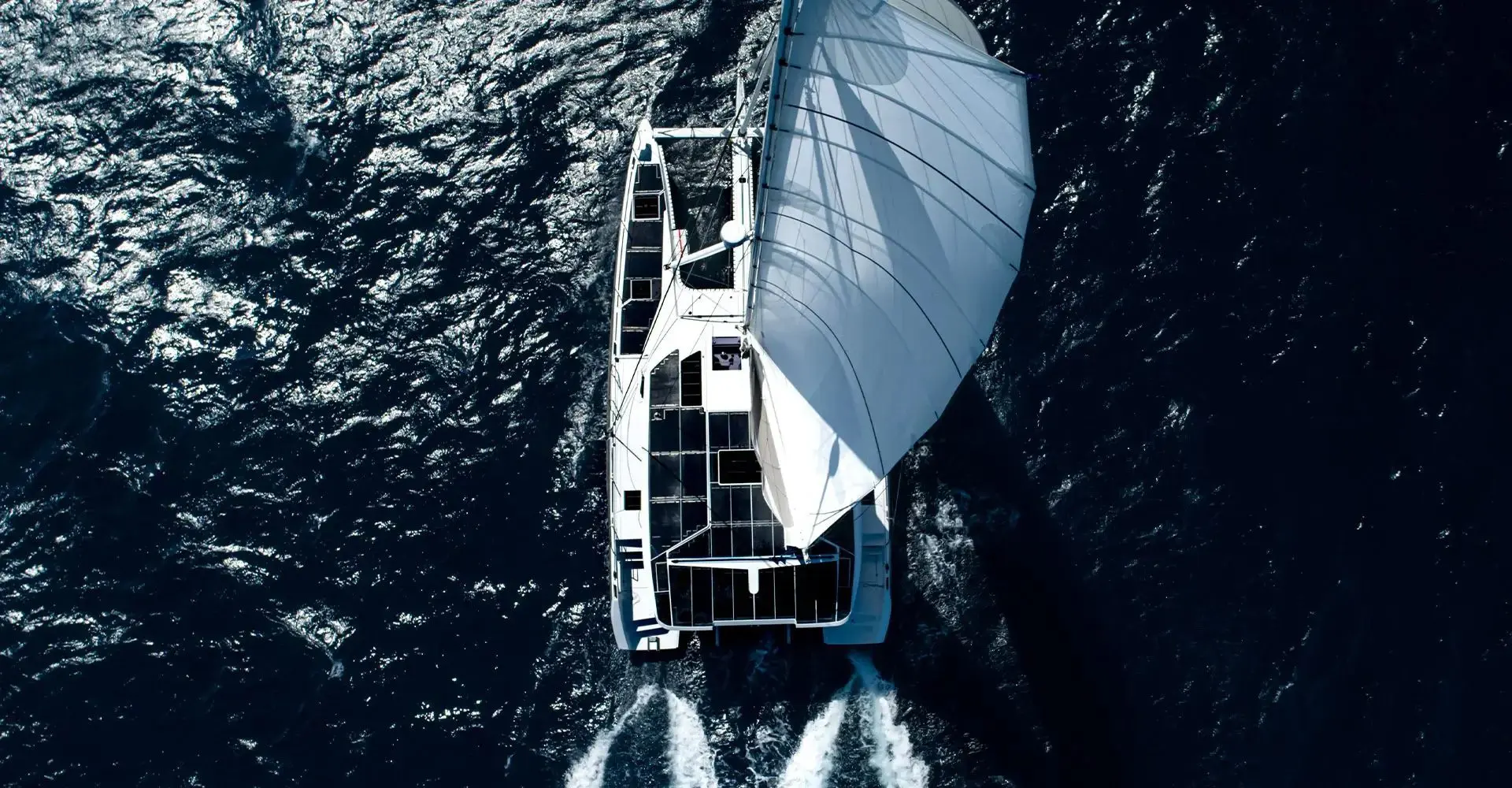
The Windelo 50 runs on solar power stored in a lithium battery bank, with electric motors for propulsion. When the boat is sailing fast enough, those same motors generate electricity. A diesel range extender provides the safety net for passages when the solar arithmetic does not balance.
Solar generation
Up to 5.7 kWp of flexible panels on the coachroof and foredeck charge the battery bank directly. In good Mediterranean sun, this typically covers hotel load — instruments, lighting, watermaker, refrigeration — and adds to the battery reserve. The daily yield varies with cloud cover, sun angle, and how much of the day the sails are shading the coachroof. You learn to check it regularly.
Battery bank and electric motors
1,120 Ah of lithium storage drives twin 20 kW motors. At harbour speed the boat is precise and near-silent. At passage speed under sail, the same motors spin as hydrogenerators — returning energy to the bank rather than consuming it. The higher the boat speed, the more they generate. Running the motors in regeneration mode and monitoring the return rate becomes part of the normal passage routine.
Diesel range extender
The onboard generator provides the safety net for longer passages or periods without sufficient sun. On a well-managed trip with a good sailing plan, it runs rarely. Its presence means there is always a fallback — but using it routinely signals that the energy planning was off. Learning when to run it and when not to is part of what the coaching covers.
Seamanship
Energy management
is part of sailing this boat.
On a diesel boat, the energy question is simple: is the tank full? On Nyota, the question is more interesting. How much solar did we collect today? What is the state of charge? Can we run the watermaker this afternoon, or should we wait until we have more reserve? How fast are we sailing — are the motors generating or consuming?
These are not problems to solve. They become decisions that are routine within a day or two. What they require is attention — the same attention that goes into reading the wind, trimming the sails, or planning a tidal gate. Energy management is, in that sense, part of sailing the boat properly.
On a Volt Sail programme, you make these decisions as part of the watchkeeping routine. Not as an engineering exercise. As seamanship.
The honest part
What electric doesn’t solve.
Electric propulsion changes the sailing experience significantly. It does not remove all constraints — it replaces some with different ones.
The electric range under motor is 2–4 hours at cruising speed. Long distances under power are not practical — on a passage, you sail. The motors are for harbour, light air assistance, and regeneration when sailing fast.
The solar yield depends on sun. Overcast passages require more active management and more willingness to run the generator. In winter or in northern waters, the solar equation works less favourably than in the Mediterranean in summer.
The battery bank degrades over time and charge cycles. Specifications published by the builder reflect new equipment. Actual performance on any specific boat depends on the age and condition of that boat’s system. Verify current specs with Windelo Catamaran before making purchase decisions based on performance figures.
Common questions
Can you motor long distances on electric?
Not in the same way as diesel. The electric range is 2–4 hours at harbour speed. On a passage, you sail — the motors are for harbour manoeuvring, light air assistance, and regenerating energy when boat speed is sufficient. Planning the trip around sailing, not motoring, is the correct mental model for this boat.
What happens if the batteries run low offshore?
The boat carries a diesel generator as a range extender. It is the safety net — not the primary energy source. On a well-managed passage with a reasonable solar forecast, the generator runs rarely. Part of the coaching is learning to read the energy situation early enough that you are never reacting to a low battery rather than planning around it.
How much solar does the boat generate each day?
Up to 5.7 kWp in ideal conditions. On a good Mediterranean summer day, the panels typically cover hotel load and add to the battery reserve. Overcast days produce significantly less. The actual yield varies with sun angle, cloud cover, sail shading on the coachroof, and whether the boat is at anchor or underway. You check the input regularly and adjust behaviour accordingly.
Is the boat noticeably quieter than a diesel catamaran?
Yes — and the difference is most obvious at anchor. Without a generator running, the boat is silent beyond wind and water. No vibration through the hull at six in the morning. No exhaust smell when manoeuvring in harbour. Most guests who have spent time on diesel boats notice the difference by the first evening. By day three it becomes the new normal.
Do I need technical knowledge about electric systems?
No prior knowledge needed. The system is explained during the handover and becomes intuitive quickly. The main practical skills — reading the state of charge, checking the solar input, deciding when to run the generator — are straightforward once you have seen them in context. Energy management is covered as part of the sailing programme, not as a separate technical course.
Ready to sail electric?
Every programme we run is on Nyota — a fully electric Windelo 50. Whether you join for a week of cruising, an offshore transit, or an extended sea trial, the boat is always the same boat.